AI Slop Detector: Finding Real Humans Online
Eric Guyer
2 min read
March 2026
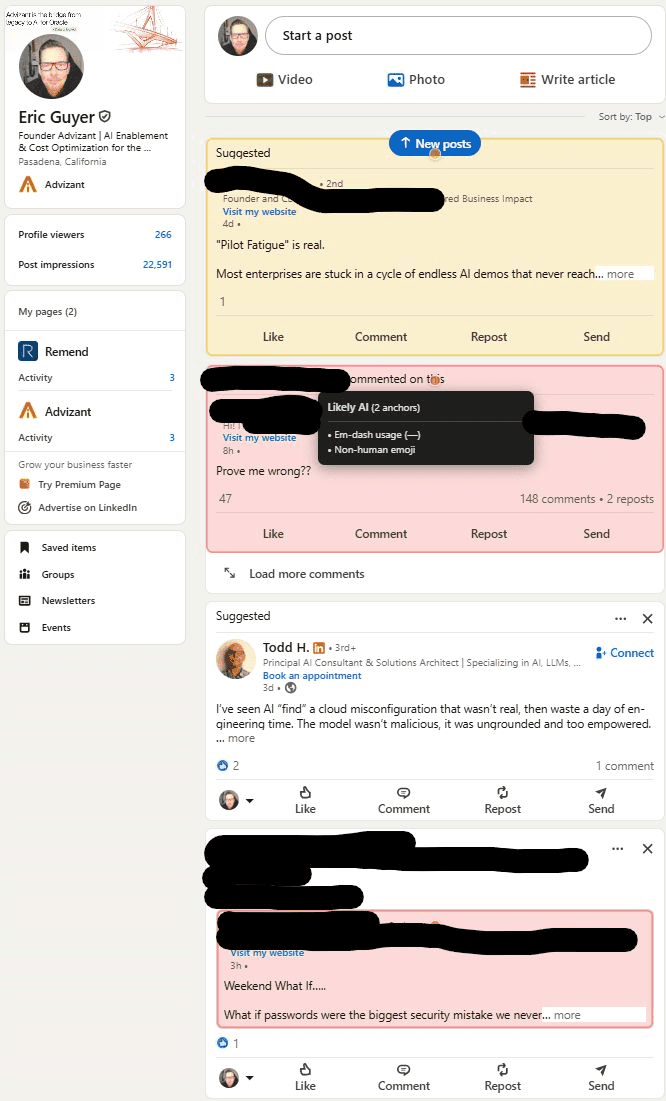
GitHub URL in comments ... I spent $1,445 on my LinkedIn Campaign 'Oracle FY26 - Uncharted Waters' from March 13 - 28. This got me wondering how much of everyone's feeds are #AI slop, which inspired me to vibe code linkedin-ai-detector, a Chrome extension.
Perhaps the future is AI agents interacting with each other on our behalves while we live lives of leisure and abundance. Until then, I prefer to hear from imperfect humans, and hope that what I have to say matters to my network. To that end, I try to be interesting and offer value (insert halo emoji). I especially hope that my Campaigns investment isn't drowned in noise. Who's with me?
While I intend to eventually publish the extension in Chrome Web Store, I've already learned how difficult LinkedIn will make it to de-slop one's feed. It changes the DOM randomly. And of course AI will improve, better mimicking humanness. For now, one must download the extension from GitHub, navigate to chrome://extensions/, enable Developer mode, and click Load unpacked.
For version 1.0, I asked Anthropic #ClaudeCode to create a comprehensive set of AI tells, resulting in 55+ fuzzy patterns, using regular expressions to identify offending posts. This approach forgoes running each post through AI, given AI is best at detecting itself. That would require the latency of a local #LLM such as LanguageModel.create() or external API call.
But the truth is, it is far too easy to spot AI-generated content. As you'll see in the code, I simplified the logic to four items: em-dashes, non-human emojis, multiple single-sentence paragraphs in a row, and the hook + bullet list + CTA formatting. Note that I used "anchor-first detection", which looks for the patterns first, then walks up the ever-changing DOM.
I'll have my swarm of agents keep working on this 😉